
About the Cause
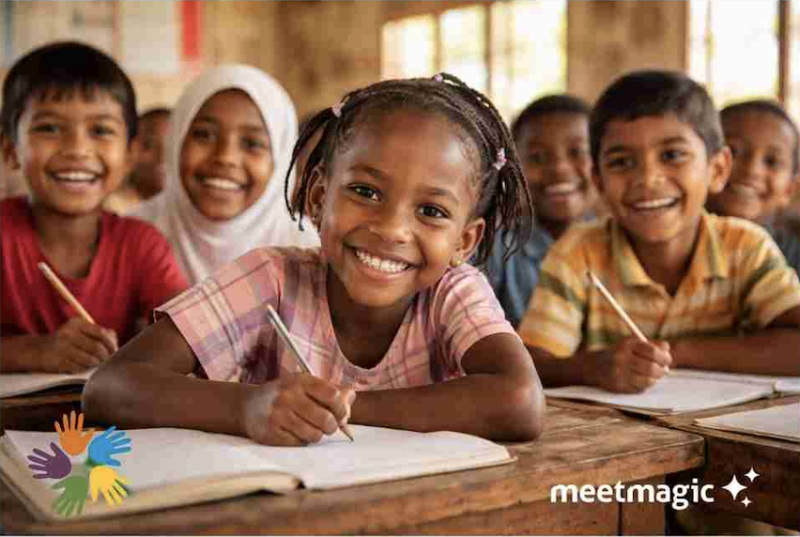
Dubai Cares’ programs are designed to reduce, if not remove, the greatest obstacles that prevent children and young people in developing countries from attaining quality education. With each intervention, Dubai Cares evaluates the need for assistance across two key areas:
Access to Education which allows Dubai Cares to improve children’s health and learning environment, increase education enrollment and attainment, increase access to education, reduce absenteeism, increase gender parity and increase promotion rates.
Quality of Education which enables early learning, enhances educational attainment and school progression, improves literacy and numeracy skills among children, enables teachers to access teacher training resulting in better learning outcomes, reduce dropout rates and increase primary school attainment.
Dubai Cares is a long-term advocate of safeguarding children and young people’s right to education and is currently playing a global advocacy role in spreading the knowledge about the importance of providing education to the unprivileged children.
We also champion education through research - There is an overwhelming lack of evidence as to what works to promote children’s learning in crisis-affected contexts. Research plays a pivotal role in tackling this issue.
My Story
Analysis of Sanitation and Hygiene Facilities Existing School Sanitation and hygiene standards puts the National sanitation standards at a ratio of 25 Girls per toilet and 35 Boys per toilet. Additionally it’s important to consider provision of urinals for both boys and girls to the ratio of 1:40 students [IRC-UNICEF WASH 2007]. On the other hand guidelines on handwashing with soap facilities requirements for schools including provision of toilet paper and handwashing facilities for the anal cleansing population to ensure proper hygiene practices are yet to be developed4. For the purpose of this report I have considered the fact that handwashing facilities should be placed strategically at critical entry points in the School compound but not limited to half the toilets to enhance hygiene after visiting the toilets. These critical points includes; gate, dining hall and library. The table below shows my analysis of scenario in the targeted Schools Challenges Identified As a result of the assessment carried out, quite a number of WASH challenges were identified in the learning institutions. These included but not limited to the following; 1) Learning Institutions in the Ward and by extension in the Sub County have poor access to safe and quality water services. This is characterized by sourcing drinking water from unimproved sources that are not reliable. The inherent limited water services witnessed in Schools also affect the Schools’ surrounding community. 2) Sanitation services in most schools vary from limited to no service and in most cases where available is below minimum standards set by Ministry of Education - MOE 3) Safe hygiene practice in almost 50% of the Institutions is limited. In institutions where few hand-washing facilities are provided there is either no water or both water and soap is not available. 4) In all the Schools, there is Non-existent, irrelevant or passive health and hygiene education for children. This is due to the fact that either the MOE has not integrated Hygiene Education in the curriculum or there is deliberate omission by the School managers who feel it’s not important. Proposed Interventions The remedial measures and/or interventions that this report proposes will oscillate around the four thematic areas of this assessment. The proposals require sector actors of good will to mobilize resources and address gaps identified in: a) Provision of Water services in Schools and surrounding community. b) Construction of Sanitation facilities where deficits exist. c) Assist in provision of handwashing facilities where there is non-existing or inadequate to prevent diseases including Covid 19. Together with facilities is provision of initial stock of soap at a ratio of 250g/pupil/month. [Sphere Standards] d) Investment in creation of hygiene education programme in Schools in strict conformity to the MOE guidelines and strategies. The program should target training of teachers to equip them with education hygiene skills, provision of IEC materials and implement hygiene promotion events. Specific Activities Activities to be executed by sector actors to implement proposals well highlighted are more obvious safe for provision of drinking water services that are bound to vary from one site to another. However, based on existing hydrological and geological survey reports, Likuyani Sub County is endowed with deep ground water resource and plenty of surface water existing in available dams and river Nzoia. Based on cost analysis, capital investments in surface water infrastructure facilities is high though with more service area coverage compared to groundwater sources. For the purpose of this report, proposed activities to address water services provision will be limited to drilling and equipping of boreholes ranging from 150m to 250m depth