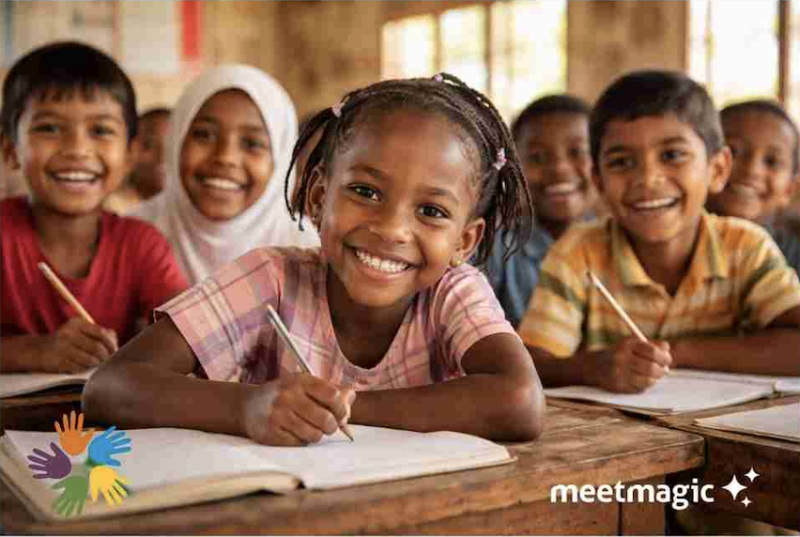

Vibrant ECCD centers-preparing for schools

By kiran kaushal

Expired

The objective of the campaign is to ensure that at least 75% of the children in the selected 5 centres in Kotra block of Udaipur district in Rajasthan, achieve school readiness through the accomplishment of developmental milestones in all the five critical developmental domains.

Education (General)

AED 299,052.00

About the Cause

Dubai Cares’ programs are designed to reduce, if not remove, the greatest obstacles that prevent children and young people in developing countries from attaining quality education. With each intervention, Dubai Cares evaluates the need for assistance across two key areas: 
 
Access to Education which allows Dubai Cares to improve children’s health and learning environment, increase education enrollment and attainment, increase access to education, reduce absenteeism, increase gender parity and increase promotion rates.
 
Quality of Education which enables early learning, enhances educational attainment and school progression, improves literacy and numeracy skills among children, enables teachers to access teacher training resulting in better learning outcomes, reduce dropout rates and increase primary school attainment.

Dubai Cares is a long-term advocate of safeguarding children and young people’s right to education and is currently playing a global advocacy role in spreading the knowledge about the importance of providing education to the unprivileged children.
We also champion education through research - There is an overwhelming lack of evidence as to what works to promote children’s learning in crisis-affected contexts. Research plays a pivotal role in tackling this issue.
 

My Story

As per the National academic survey data the average performance of the students nationally in language is barely 56.7% and in numeracy it is only at 51.8 % at the grade 5 level (completion of the primary level of the schooling cycle) which means that majority of the children are still far away from attaining their age appropriate competency levels required for them to attain their full potential. Consultations with 2000 children and their families indicated that the socio –emotional reasons had a vital role to play in their deciding to drop out. One of the major reason for this is lack of faith in traditionally good child rearing practices (storytelling, singing etc.) and lack of convergence of the same with modern knowledge.The lack of emphasis on developing school readiness in children during the early childhood years, despite the fact that ECE Policy (2013) stresses the importance of promoting it also contributes to the problem. As our observations in the field suggest that in more than 80% of the project locations ECCE component is missing in the early childhood centres. About 50% of the 6000 Children in the 3- 5 years age group achieve school readiness, 70% of the 50,000 children in the 6-14 years age group achieve socio- emotional skills for learning and 40% of the 50,000 children in this age group achieve age appropriate learning competencies defined by National Council for Education Research and Training (NCERT). India climbed one spot to 115 out of 189 countries in the latest human development rankings released today by the United Nations Development Programme (UNDP). Recent NFHS data shows that almost 46% children are underweight with merely one percent improvement over last survey. Almost 80% of children bet ween 3 to 35 months old are anemic. Approximate 9.3% children are found to be underage in the school. Inadequate early childhood education leads to incomplete readiness for the schools. This calls for the key approaches such as : • Strengthening the ECCE component in the ICDS center through capacitating the Anganwadi worker. • Mapping out existing resources and drawing synergies for maximizing the inputs for better implementation of the other services at anganwadi. • Reaching out to the larger community, identifying leaders and active members there in to further ensure the sustainability and support to the interventions The campaign is based on the theory that the social change requires impacting on multiple levels and multiple dimensions. Here we believe that in order to achieve the target of SDG 4.2 , the requirement is of comprehensive and integrated approach.

For better web experience, please use the website in portrait mode